

Scott told the audience at IAAPA that Katmandu made a conscious decision to avoid off-the-shelf rides in their new theme park, instead, opting for new ride delivery systems. Falcon’s felt this was a great opportunity to launch Suspended Theater™, a one-of-a-kind flying theater that utilizes patented technology to create a unique reveal, immersing guests in powerful 3D media in a way no one has ever before experienced.
The ride hardware for Suspended Theater™ is being provided by Oceaneering, and Kraftwerk Living Technologies will bring their audiovisual expertise to the attraction. Falcon’s is designing the custom media for the experience, which will bring Katmandu’s characters to vibrant life.
Falcon’s is well underway on master planning and attraction and media design for the entire park. In addition to the flying theater, there are several other unique environments that will serve as the home for fascinating experiences. The Katmandu IP will play a prominent role in all attractions. The stories will introduce a few new characters, but the spotlight will remain on established favorites like Kilgore Goode, the Desirata and Boro, the great yeti. Two other recognizable faces from the franchise, mythical yetis Maiya and Kumar, were on hand at the press event to introduce the sneak preview video of Katmandu Punta Cana.
To quote Scott Demerau, “Falcon’s has really been a game-changer for us.” Both teams are very excited about stretching the boundaries of this amazing brand and introducing this magical IP to audiences across North America.
Falcon’s Creative Group takes their job as IP ambassadors seriously, no matter how large or small the investment. In this case, Katmandu Group is injecting upwards of $80 million into this one project. Punta Cana could become a steppingstone to growing the brand in other ways. Who knows what the future holds, but with the strong bond between Katmandu Group and Falcon’s, the multiverse is the limit!
Watch the full press event here: Falcon’s and Katmandu IAAPA Press Event
Although we don’t design or spec acoustics for our attractions, our designers and engineers at Falcon’s are sensitive to the importance of acoustical treatment, and that has made a huge difference in many of our recent attractions.
In general, it’s quite easy and inexpensive to add acoustical treatment to ceilings and walls while in the earlier stages of construction. Adding acoustics later is very time consuming, messy, disruptive, and much more costly. So, when we are able to suggest that acoustics be implemented early on in the process, it makes a world of difference.
Audio clip from Queens Of Egypt Exhibition by National Geographic Society.
One notable example that our design team was able to help with greatly, was the National Geographic Museum in Washington DC. One of the main attractions in the museum is a 3D immersive theater with 7.1 surround sound. This theater was home to some amazing productions created by our media team, such as “The Tomb of Christ”, later followed by “Queens of Egypt”.
The room started out with a bare ceiling, concrete floor and a solid projection screen that enveloped the guests in a horseshoe shape. This meant that sound would be bouncing off several huge hard surfaces, which would have created a dialog nightmare. Carpeting was out of the question because the floor was also a projection surface. The screen itself can’t be treated, so the main area that was open to work with was the ceiling. The solution was to hang what are called acoustical clouds, which are panels hung by cables from the high ceiling and treated with black acoustical foam which basically goes unseen by the guests.
Taking care of acoustics in the ceiling makes a substantial difference, even when the other surfaces can’t be touched. The team however was able to add some treatment to the walls above the screen which was quite helpful as well.
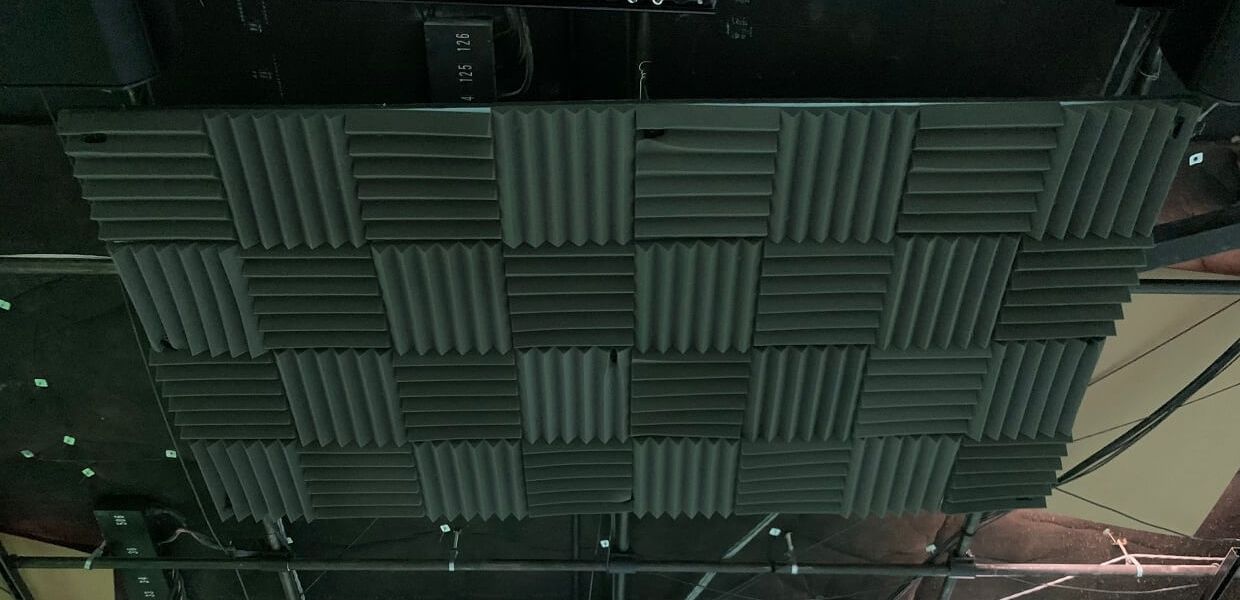
So how does this type of foam treatment work? It takes just a small bit of science to help explain. The acoustical treatment must be thick enough to absorb the problematic sound waves and keep them from bouncing back at you. The lowest frequency in our hearing range is 20 hertz. Would you believe the length of that sound wave is about 54 feet long?
Think of it as a 54-foot-wide and 30-foot-high sea swell in the middle of the ocean. That’s the size of the wave that travels unseen through the air. Compare that to 20,000 Hertz, the highest perceptible frequency which has a wavelength of just over 1/2 inch. The human voice is in the mid to upper part of that range.
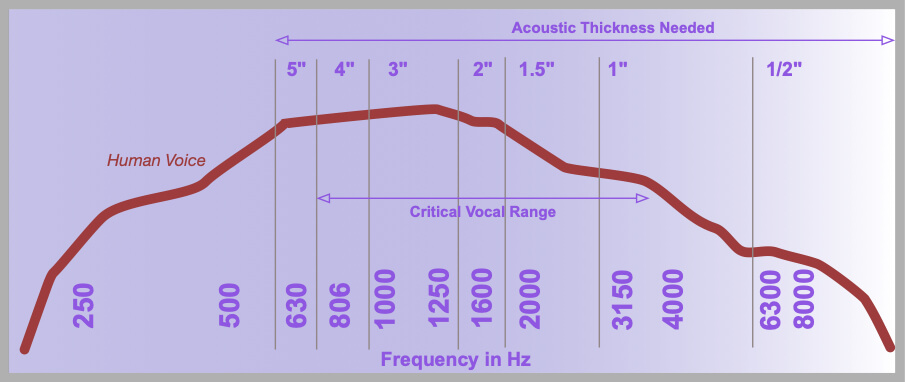
Those huge low frequency waves are pretty much impossible to absorb, but the human vocal range is very achievable. Without getting too deep into the math of it all, the basic rule of thumb is called the quarter rule. This just means that if your foam is a least as thick as 1/4 of the length of the sound waves that are causing the biggest problems, then you’re in pretty good shape. 3-4 inches of acoustic thickness will take care of most of the havoc created by dialog in an attraction, and at the same time, the music and effects will be considerably better sounding. But I’m happy when I can get an inch or two of treatment.
Acoustics are sometimes not valued as much as choosing great speakers and having a good design for placement. But when all three of these things are taken into consideration, we have the foundation to create an amazing sound mix.
About the Author
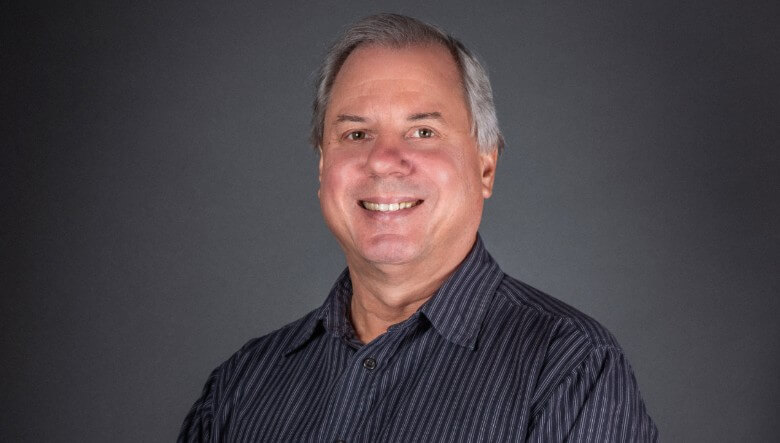
Rick Morris
Director of Sound
Rick is an Academy Award nominated sound editor that brings Falcon’s invaluable expertise in attraction sound design and mixing His dedication, portfolio, and accomplishments has catapulted Falcon’s into the cutting edge of immersive design.